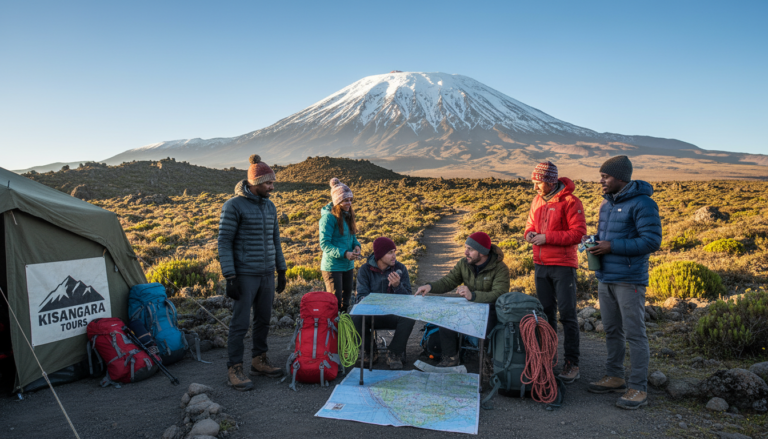
We invite you to step into a realm where the earth reaches for the sky. Here, ancient volcanic forces sculpted Africa’s most iconic summit. This is a place of breathtaking grandeur.

This peak is more than a geographical feature. It is a testament to the raw power of creation. Mount Kilimanjaro stands as the tallest in Africa and the highest free-standing mountain in the world. Its summit, Uhuru Point, rests at 19,341 feet.
It calls to adventurers and dreamers from every corner of the globe. This majestic giant is one of the legendary Seven Summits. We explore it as a living cathedral of ecosystems. Each layer tells a chapter in Earth’s ancient story.
We begin our journey with essential kilimanjaro facts. We honor the sacred relationship between this mountain and humanity. This is the heart of Kilimanjaro National Park.
Key Takeaways
- Mount Kilimanjaro is Africa’s tallest peak and the world’s highest free-standing mountain.
- The summit is known as Uhuru Point, reaching 19,341 feet (5,895 meters) above sea level.
- It holds a place among the Seven Summits, the highest mountains on each continent.
- The climb is considered non-technical, not requiring specialized mountaineering gear.
- The mountain is a protected centerpiece of a vast and diverse national park.
- Its slopes contain distinct ecological zones, each with unique life.
- It represents a powerful, transformative journey for those who answer its call.
Overview: Discovering Tanzania’s Iconic Natural Wonder
We witness the earth’s majesty in its purest form: a mountain that needs no mountain range to define its grandeur. Unlike the Himalayas where peaks huddle together, this colossal formation stands sovereign. It rises in splendid isolation from the Tanzanian plains, a volcanic titan born from ancient eruptions.

The summit called Uhuru Peak—meaning “freedom” in Swahili—reaches 19,341 feet toward the heavens. This makes Mount Kilimanjaro not just Africa tallest sentinel, but the highest free-standing mountain in the world. Its protected status as a UNESCO World Heritage Site honors this unique treasure.
We understand this peak as both geographical apex and spiritual destination. Within its slopes, entire ecosystems unfold like chapters in Earth’s story. For those who answer its call, the journey becomes a pilgrimage where modern life meets ancient wilderness.
Early History and the First Ascents of Mount Kilimanjaro
Long before the first boots crunched its volcanic scree, the mountain existed in legend and whispered awe. Its snow-capped peak, known as Kibo to the Chagga people, was a symbol of greatness for centuries. The earliest written account comes from Ptolemy of Alexandria, who described a “large snow mountain” long ago.
This history is a rich tapestry of human endeavor. It culminates in the first documented ascent over a century ago.
Hans Meyer’s Breakthrough Journey
The story of the first successful climb is one of perseverance. German geologist hans meyer made three attempts to conquer mount kilimanjaro. His initial effort years ago failed at the icy walls of Kibo.
Political unrest thwarted his second try. But hans meyer did not give up. His third attempt in 1889 was a triumph of partnership.
He collaborated with Austrian climber Ludwig Purtscheller and a local guide, Yohani Kinyala Lauwo. Together, they finally reached summit of Uhuru Peak. This historic moment changed exploration forever.
| Year | Outcome | Key Reason |
|---|---|---|
| 1887 | Failed | Lacked equipment for ice and snow |
| 1888 | Failed | Captured during the Abushiri Revolt |
| 1889 | Success | Collaboration with local guide and team |
Legends and Local Narratives
Long before that first ascent, the mountain was alive in local stories. Its name itself holds mystery. Some interpretations suggest “mountain of whiteness” or “mountain of caravans.”
These narratives speak of a powerful, almost spiritual presence. They remind us that every climber today walks paths first imagined long ago.
Geological Wonders: The Three Volcanic Cones of Kilimanjaro
We uncover the ancient fires that built Africa’s roof, a process that created not a single summit but a trio of volcanic cones. Each cone tells a different chapter in an epic story of creation and change.

Kibo, Mawenzi, and Shira Explained
The central and tallest of the three volcanic cones is Kibo. It is a dormant volcano, meaning it could awaken again. This youngest cone formed 460,000 years ago and cradles the famous Uhuru peak.
To the east stands Mawenzi. Its jagged profile marks it as an extinct volcano. It ranks as the third-highest peak in Africa, a silent sentinel of raw power.
Shira, the westernmost cone, is also extinct. Its story is one of collapsed grandeur. It is no longer a peak but a vast plateau, a testament to the mountain’s dynamic past.
| Cone Name | Status | Height (feet/meters) | Key Characteristic |
|---|---|---|---|
| Kibo | Dormant | 19,340′ / 5,895m | Youngest cone; contains the summit |
| Mawenzi | Extinct | 16,893′ / 5,149m | Africa’s third-highest peak; rugged and craggy |
| Shira | Extinct | Plateau at 13,000′ / 3,962m | Collapsed crater forming the Shira Plateau |
The last major eruption shook the earth 360,000 years ago. This timeline humbles us, placing human history against the deep clock of geology.
Ecological Diversity and Climate Zones
Within this single majestic peak lies the climatic diversity of an entire continent compressed into vertical space. The climb offers an extraordinary experience through five distinct ecological zones, each a complete world unto itself.

We begin where the earth feels most familiar. The cultivated lower slopes give way to lush rainforests where ancient trees create emerald cathedrals.
Rainforest, Moorland, and Cultivated Zones
The rainforest envelops climbers in vibrant life. Moisture drips from canopies that shelter unique flora and fauna found nowhere else.
As we ascend, the landscape transforms dramatically. The moorland zone reveals otherworldly plants adapted to harsh conditions. Giant groundsels and lobelias stand as silent sentinels.
This middle section of the mountain teaches us about resilience. Life persists in forms that defy expectation.
Alpine Desert and Arctic Landscapes
The transition into the alpine desert marks a profound shift. Vegetation surrenders to geology, and the air thins with every step upward.
Finally, we reach the arctic summit—a realm of ice and rock where permanent human presence is impossible. This crown of the mountain challenges both body and spirit.
Each of these zones demands different preparation. The journey through these ecological bands makes the ascent more than physical achievement—it becomes a pilgrimage through Earth’s diversity.
The Melting Ice Cap: Climate Change Impact on Kilimanjaro
We stand before a vanishing crown, watching as millennia of frozen history retreat before our eyes. The legendary glaciers that have defined this peak are disappearing in a transformation both profound and sobering.

Rapid Ice Loss Over the Past Century
Scientists have documented an alarming truth: since 1912, the ice cap has shrunk by 82%. What once seemed eternal now exists as mere fragments of its former glory.
The mechanisms of loss are twofold. Direct melting combines with sublimation, where ice transforms directly to vapor. This dual assault accelerates the disappearance of ancient snow fields.
Future Predictions and Environmental Concerns
With only 20% of the historic coverage remaining, projections suggest complete disappearance within decades. We may witness the last of this equatorial ice within our lifetime.
Conservation efforts offer glimmers of hope. In 2008, nearly 5 million indigenous trees were planted around the base. Yet time presses forward, and the outcome remains uncertain.
This environmental concern transforms every journey to mount kilimanjaro into an act of witness. The window to experience these vanishing glaciers narrows with each passing year.
Challenges on the Climb: Acute Mountain Sickness and Altitude
There is an invisible adversary on this journey, one that respects neither strength nor determination—the altitude itself. This silent challenge separates successful ascents from necessary retreats.

Acute mountain sickness affects climbers when their bodies struggle with reduced oxygen. Headaches, nausea, and dizziness signal this mountain sickness.
The most serious forms can be fatal. Pulmonary edema floods the lungs with fluid. Cerebral edema causes dangerous brain swelling.
Between five and fifteen people perish here annually. Most succumb to hypothermia or altitude-related complications. This reminds us that respect for the mountain is essential.
Even elite athletes have turned back due to acute mountain challenges. Fitness alone cannot guarantee summit success against thinning air.
Time becomes the greatest medicine for acclimatization. Success rates climb from 27% on rushed five-day routes to 98% on properly paced expeditions. Approximately half of all climbers will not reach their goal due to altitude issues.
We monitor every person for symptoms of this mountain sickness. We carry emergency oxygen and prioritize descent when acute mountain sickness threatens. No peak is worth a life.
Popular Climbing Routes and What to Expect
The path you choose becomes the story you tell. Seven official trails weave their way upward, each with a distinct character and rhythm. Your selection shapes the entire climbing kilimanjaro experience.

We guide you through these options with care. The right route matches your spirit, your stamina, and the time you have to listen to the mountain.
Marangu, Machame, and Lemosho Routes
The Marangu route, following Hans Meyer’s historic path, is famously called the “Coca-Cola” route. Its popularity, however, belies a challenge. The standard five-day schedule offers little time for the body to adjust to the altitude.
We often favor the Machame route, the “Whiskey Route.” It demands more over six to seven days. This climb rewards effort with stunning ecological diversity and superior acclimatization.
For the most scenic approach, the Lemosho route is unparalleled. It begins on the wild western flank, crossing the vast Shira Plateau. This path offers a gentle start and the highest chance of summit success.
Alternative Paths and Their Unique Features
Other paths offer solitude and unique perspectives. The Rongai route ascends from the north, providing drier conditions and dramatic views of Mawenzi peak.
The Northern Circuit is the longest journey. It circles the peak, allowing for profound acclimatization and a truly immersive experience.
Tanzania requires all adventurers to use an authorized route with a licensed guide. This rule protects the fragile environment and ensures every climber‘s safety.
| Route Name | Typical Duration | Common Nickname | Key Feature | Success Rate |
|---|---|---|---|---|
| Marangu | 5-6 days | Coca-Cola Route | Historic path, hut accommodation | Lower |
| Machame | 6-7 days | Whiskey Route | High scenic variety, excellent acclimatization | High |
| Lemosho | 7-8 days | Scenic Route | Remote start, crosses Shira Plateau | Very High |
| Rongai | 6-7 days | Wilderness Route | Drier climate, views of Mawenzi | High |
Kilimanjaro as One of the Seven Summits
There exists a sacred fellowship among the world’s highest points, and our Tanzanian giant claims its rightful place within this hallowed circle. The seven summits represent more than geographical statistics—they embody human aspiration across continents.

We celebrate this peak’s position as Africa’s contribution to this legendary collection. It stands fourth in elevation yet first in accessibility among these continental monarchs.
| Mountain | Continent | Height (feet/meters) | Technical Difficulty | Notable Feature |
|---|---|---|---|---|
| Everest | Asia | 29,035′ / 8,850m | Extreme | World’s highest peak |
| Aconcagua | South America | 22,834′ / 6,960m | High | Highest outside Asia |
| Denali | North America | 20,310′ / 6,190m | High | Extreme weather challenges |
| Mount Kilimanjaro | Africa | 19,340′ / 5,895m | Non-technical | Highest free-standing |
| Elbrus | Europe | 18,513′ / 5,642m | Moderate | Volcanic peaks |
| Vinson | Antarctica | 16,050′ / 4,892m | Moderate | Remote polar location |
| Carstensz Pyramid | Oceania | 16,023′ / 4,884m | Extreme | Technical rock climbing |
While other summit attempts demand ropes and ice axes, this ascent requires only determination and proper acclimatization. This accessibility makes climbing kilimanjaro an ideal introduction to high-altitude achievement.
The seven summits represent not just peaks to conquer, but continents to understand—each telling a different story of our planet’s grandeur.
We remind every adventurer that “easiest” among the seven summits never means “easy.” The altitude remains a formidable challenge that demands respect. This mountain world achievement transforms visitors into witnesses of global geological majesty.
Record-Breaking Feats and Incredible Climbing Stories
Human ambition finds its ultimate expression in the race against time on this great peak. We marvel at those who transform the ascent into a sprint, rewriting the limits of human endurance.

These athletes turn the trail into a track, where every second counts toward a new world record.
Speed Climb Records and Notable Achievements
The Swiss-Ecuadorian athlete karl egloff achieved a feat that seems almost superhuman. His round-trip ascent and descent took a mere 6 hours 42 minutes.
This shattered previous marks and stands as a testament to perfect preparation. Other legends like Kilian Jornet reached the summit in just over 5 hours.
German climber Anne-Marie Flammersfeld set the women’s record. Her incredible effort took 8 hours 32 minutes to reached summit.
These achievements are not just about speed. They represent weeks of acclimatization and profound respect for the mountain’s challenge.
| Athlete | Nationality | Achievement | Time (Hours:Minutes) | Year |
|---|---|---|---|---|
| karl egloff | Swiss-Ecuadorian | Fastest Ascent & Descent | 6:42 | 2014 |
| Kilian Jornet | Spanish | Fastest Ascent | 5:23 | 2010 |
| Anne-Marie Flammersfeld | German | Women’s Ascent Record | 8:32 | 2015 |
| Simon Mtuy | Tanzanian | Fastest Unaided Climb | 9:19 | 2006 |
Anecdotes of Triumph and Challenge
Beyond pure athleticism, the peak has hosted unique human stories. In 2016, a pizza delivery created a world record at the top.
DJ Joozey became the first to perform music at Uhuru Peak. These moments add a layer of whimsy to the solemnity of climbing kilimanjaro.
We celebrate every journey, whether it takes hours or days. Each successful summit is a personal victory against the elements.
Diverse Flora and Fauna on and Around Kilimanjaro
The mountain breathes with a living pulse, where ancient forests shelter secrets and wildlife thrives in vertical kingdoms. This is not merely stone and ice but a vibrant ecosystem supporting over 140 mammal species.

We guide you through forests where leopards prowl shadows and blue monkeys swing through canopies. Twenty-four bat species navigate darkness while honey badgers defend their territory. Nearly 180 bird species fill the air with song.
The discovery of Africa’s tallest tree here in 2016 reminds us this mountain still harbors ancient secrets. The Entandrophragma Excelsum stands possibly 500 years old—a living testament to time.
This biodiversity forms part of a greater world where human communities have lived for centuries. The Chagga people farm fertile volcanic soil while Maasai herdsmen move through western foothills.
Eighteen forest villages maintain traditional relationships with the land. They keep bees, hunt sustainably, and honor the balance between use and preservation.
Every climb becomes a richer experience when you encounter this interconnected life. You ascend for the summit but discover an entire world along the way. This part of the journey transforms the mountain from challenge to sanctuary.
Inspiring Journeys: Personal Stories from Kilimanjaro Climbers
The true summit of this mountain is not measured in feet, but in the human spirit it awakens. We have witnessed extraordinary journeys that redefine possibility.
Anne Lorimor reached the peak at 89 years old, proving that determination transcends calendar pages. Meanwhile, Coaltan Tanner stood triumphant at just six years old.
Triumphs of the Young and the Old
These climbers show that age defines neither courage nor capability. With proper guide support, even children achieve extraordinary feats.
We honor those overcoming profound challenges. Bernard Goosen summited twice with cerebral palsy. Kyle Maynard climbed without forearms or lower legs.
The experience of climbing kilimanjaro becomes deeply personal. Every successful summit represents victory over doubt.
Even elite athletes face humbling moments here. The mountain respects no reputation, only preparation and spirit.
These stories remind us that climbing kilimanjaro welcomes all who approach with respect. Each journey transforms ordinary climbers into witnesses of human potential.
Essential Climbing Preparations and Gear Recommendations
Success on Africa’s rooftop is woven from three essential threads: the right equipment, physical readiness, and experienced local wisdom. While this journey requires no technical mountaineering skills, proper preparation transforms challenge into achievable adventure.
The right gear makes the difference between misery and magic. Layered clothing systems, broken-in hiking boots, and sub-zero sleeping bags become your trusted companions against extreme temperature variations.
Training Tips for First-Time Adventurers
Physical preparation should begin months before your climb kilimanjaro adventure. Cardiovascular training builds the endurance needed for long days on the trail. Hiking with weighted packs conditions your legs and back for the real challenge.
Choosing your guides separates success from disappointment. Reputable operations provide multiple guides per climb and carry comprehensive medical equipment. They prioritize safety over summit statistics.
We’ve guided thousands safely because our experience becomes your foundation. With proper preparation, appropriate gear, and qualified guides, your climbing kilimanjaro experience transforms from impossibility to achievement.
Essential Insights: kilimanjaro national park, kilimanjaro facts
We gather the threads of history, conservation, and human achievement that weave the complete tapestry of this African giant. These essential kilimanjaro facts transform statistics into understanding, numbers into meaning.
The protected expanse of Kilimanjaro National Park spans 1,668 square kilometers of precious heritage. Every adventurer must walk with licensed guides on authorized routes—regulations designed for both safety and preservation.
Between 25,000 and 35,000 people attempt to climb kilimanjaro each year. Yet only about half reach the summit, making proper preparation the difference between statistics and success.
We honor the East African Mountain Club’s pioneering work in the 1920s. They built the first rest huts and trained the initial guides before Tanzania assumed management in 1973.
Conservation facts inspire responsibility: the 2008 planting of 5 million indigenous trees demonstrates community commitment. At the summit, a wooden box holds a book where nearly every successful climber records their reflections.
Understanding these essential facts means recognizing you’re not merely climbing a mountain. You’re participating in a carefully managed, culturally significant experience that transforms adventure into reverence.
Safety Measures and Tips for Preventing Altitude Sickness
Altitude becomes the silent teacher on this pilgrimage, reminding us that humility is the true path to the summit. We walk with careful attention to your body’s whispers before they become shouts of distress.
Our guides receive intensive High Altitude First Responder training, transforming them into medical guardians. They monitor oxygen levels and pulse rates multiple times daily, watching for headaches or nausea that signal altitude challenges.
Prevention begins before your boots touch the trail. Choosing longer routes gives your body precious time to adapt. Success rates leap from 27% on rushed five-day climb schedules to 98% on properly paced journeys.
The golden rules are simple yet profound: pole pole (slowly slowly), drink abundantly, eat without appetite, and speak honestly about symptoms. We carry emergency oxygen and maintain communication systems for immediate response.
Over the years, we’ve learned that turning back demonstrates greater courage than pushing upward. Your guide must sometimes make the difficult decision to descend when the mountain speaks through your body. Reaching the summit matters far less than returning safely to those who love you.
Contact and Booking Information
The journey to Africa’s rooftop begins not with a step on the trail, but with a conversation that bridges continents and dreams. We welcome your questions and aspirations—our team stands ready to transform visions into carefully planned reality.
Call Us: +255 755 002 886 | +255 783 292 929
Reaching us is your first step toward achievement. Speak directly with our experienced planning team who understand both the ascent and your unique needs. We’re available across time zones to accommodate international travelers.
Email: info@kisangaratours.com | kisangaratours@gmail.com
For detailed inquiries or itinerary requests, email allows thoughtful conversation. We respond personally to every message, offering comprehensive consultation based on your experience level and goals.
Our booking process is transparent and thorough. We explain exactly what’s included and what to expect each day. As local Tanzanian operators, we build trust through clear communication.
| Adventure Type | Ideal For | Key Features | Preparation Support |
|---|---|---|---|
| Solo Journey | Personal transformation seekers | Focused guidance, personal pace | Individual training plan |
| Couples Ascent | Shared achievement partners | Intimate experience, paired accommodation | Joint preparation strategy |
| Group Expedition | Teams and friends | Private guiding, group dynamics | Collective training sessions |
Whether you seek solitary reflection or shared triumph, we customize each expedition while maintaining uncompromising safety standards. Contact us today—your transformative adventure begins with a simple connection.
Conclusion
The call of this peak echoes across continents, inviting transformation through challenge and reverence. Every step upward becomes a meditation on human potential against ancient geology.
We’ve shared essential facts that reveal Mount Kilimanjaro as more than Africa’s highest summit. It represents a journey where personal limits dissolve into achievement. The mountain offers one of the world‘s most accessible yet profoundly challenging adventures.
Whether you seek to climb Kilimanjaro as a personal test or witness vanishing glaciers, responsible tourism becomes our shared duty. The window to experience this crown of snow narrows with each season.
We invite you to add your story to this living legacy. The Roof of Africa awaits those ready to transform adventure into reverence.
FAQ
What are the three volcanic cones that form the mountain?
How serious is acute mountain sickness on the ascent?
Which climbing route is best for a first-time adventurer?
How long does it typically take to reach Uhuru Peak?
What kind of wildlife might we encounter on the climb?
What is the best time of year to plan a climb?

Frida Cliff
Farida Clif is the founder of Kisangara Tours and a seasoned safari expert with years of experience in Tanzania’s travel industry. She is dedicated to crafting authentic safari experiences that highlight the country’s wildlife, culture, and natural beauty.