Kisangara Tours

Kisangara Tours — Header
KILIMANJARO
The Roof of Africa · 5,895m

Kilimanjaro. Africa's Summit.

Six routes. Five ecological zones. 91% summit rate with Kisangara's certified mountain guides.

Scroll
Destinations Serengeti National Park
Summit Mount Kilimanjaro 5,895m
Crater Ngorongoro · 25,000 Animals
Islands Zanzibar · Pemba · Mafia
Wildlife Great Wildebeest Migration
Western Gombe Chimpanzee Trekking
Southern Ruaha · Nyerere
Est. 2009 Kisangara Tours · Arusha
Destinations Serengeti National Park
Summit Mount Kilimanjaro 5,895m
Crater Ngorongoro · 25,000 Animals
Islands Zanzibar · Pemba · Mafia
Wildlife Great Wildebeest Migration
Western Gombe Chimpanzee Trekking
Southern Ruaha · Nyerere
Est. 2009 Kisangara Tours · Arusha
5,895mUhuru Peak
6Summit Routes
91%Kisangara Summit Rate
7Ecological Zones
5,895mSummit elevation
6Official routes
91%Kisangara summit rate
8Days recommended via Lemosho
The Roof of Africa

Africa's highest
summit. Earned.

Mount Kilimanjaro is a stratovolcano rising 5,895 metres above sea level on the equatorial plains of northern Tanzania — the highest freestanding mountain on Earth and the highest point on the African continent. Unlike the technical peaks of the Himalayas or the Andes, Kilimanjaro can be climbed without ropes, ice axes, or prior mountaineering experience. What it demands instead is time, acclimatisation, fitness, and the willingness to be cold, slow, and present in one of the most extraordinary environments on Earth.

The mountain passes through five distinct ecological zones on the ascent from the base forests to the arctic summit crater: cultivated lower slopes give way to montane forest — a dense, mossy world of colobus monkeys and elephant tracks — then to heath and moorland, then to the alpine desert, and finally to the glacial arctic zone above 5,000 metres. Each zone has its own temperature, its own sounds, and its own logic. The transition from equatorial Africa at the trailhead to an ice field at the summit takes six to eight days and is one of the most concentrated ecological journeys available to any trekker.

The summit glacier is retreating. Scientific projections suggest that the iconic ice fields of Kilimanjaro — the glaciers that have capped the mountain for more than 11,000 years — will be largely gone within three to four decades. This is not a distant environmental abstraction; it is visible in photographs taken twenty years apart. The ice that exists now will not exist for the next generation. This is one of the reasons that the mountain continues to draw climbers from every country on Earth.

Kisangara's mountain division operates with a 91% summit rate — significantly above the general industry average of 65%. The difference is route selection, itinerary length, guide experience, and the physiological understanding of altitude acclimatisation that our lead guides carry from fifteen years on the mountain. We do not rush the summit. We do not cut acclimatisation days to reduce cost. We take the mountain seriously on its own terms.

The Six Routes

Choose your path.

Each route has a different character, a different duration, and a different success rate. These are the routes we recommend — and why.

01 Most Recommended · 8 Days

Lemosho Route

The Lemosho is our primary recommendation for first-time Kilimanjaro climbers. The eight-day itinerary provides the best acclimatisation profile, the most scenic approach through the western rainforest, and a low daily trekker density. The route joins the Shira Plateau at 3,800 metres — a broad volcanic plateau with views to the summit — before traversing the Southern Circuit to Barafu camp for the summit push. Summit rate: 91%.

02 Classic Route · 7–8 Days

Machame Route

The Machame — known as the Whiskey Route — is the most popular route on the mountain and offers excellent acclimatisation through its high-low-high altitude profile. The southern approach takes climbers through rainforest, heath, moorland, and alpine desert in rapid succession. The seven-day itinerary is adequate for fit, acclimatised climbers; eight days significantly improves summit rates. Stunning views of the Breach Wall. Summit rate: 88%.

03 Most Remote · 9–10 Days

Northern Circuit

The Northern Circuit is Kilimanjaro's longest and most remote route, circumnavigating the entire mountain before approaching the summit from the north. The extended duration provides the best acclimatisation profile of any route, and the northern side of the mountain is rarely seen by trekkers. Wildlife encounters — buffalo, elephant, colobus monkey — are common on the lower slopes. Recommended for climbers who want the most comprehensive Kilimanjaro experience. Summit rate: 95%.

04 Budget Route · 6 Days

Marangu Route

The Marangu — known as the Coca-Cola Route — is the only route with hut accommodation rather than tents, making it the most comfortable option. The six-day itinerary is the shortest available, which reduces the acclimatisation window and gives the lowest summit rates of the major routes. A seven or eight-day Marangu itinerary significantly improves outcomes. Suitable for climbers with prior high-altitude experience. Summit rate: 72% (6-day), 85% (8-day).

05 Scenic Approach · 7–8 Days

Rongai Route

The Rongai approaches from the north — the Kenya border side — and is the driest of the main routes, making it a reliable option during the long rains (April–May). The northern approach offers completely different vegetation and views from the standard southern routes. Less crowded than Machame or Lemosho. The descent uses the Marangu route for variety. Recommended for climbers wanting a northern perspective and dry-season reliability. Summit rate: 87%.

06 Technical · 6 Days

Umbwe Route

The Umbwe is the steepest and most direct route on the mountain — a demanding ascent through dense forest on a narrow ridge. The route is short and steep, providing less acclimatisation time and therefore lower summit rates for average fitness climbers. Recommended only for very fit climbers with prior high-altitude experience. The views from the Umbwe ridge are some of the finest on the mountain. Summit rate: 75%.

Ecological Zones

Five worlds
in one climb.

Kilimanjaro passes through five distinct ecological zones in the ascent from the forest gate to the summit crater. Each zone is a complete biological world with its own climate, vegetation, and — in the lower zones — its own wildlife.

Zone 1: Cultivated Lower Slopes (800–1,800m)
The lower slopes of Kilimanjaro are densely farmed — coffee, banana, and vegetable gardens that have been cultivated by the Chagga people for centuries. The Chagga irrigation system, using channels drawn from the mountain's permanent streams, is one of the most sophisticated traditional agricultural systems in East Africa. Trekking through these lower slopes on the Lemosho or Machame approach gives a sense of the living relationship between the mountain and the communities at its base.
Zone 2: Montane Forest (1,800–2,800m)
The montane forest zone is a dense, moisture-laden world of ancient trees draped in Spanish moss and giant ferns. Colobus monkeys are commonly seen in the canopy. Elephant, buffalo, and bushbuck tracks cross the trails regularly. The forest is coolest in the morning and can be misty and atmospheric throughout the day. Birding in the forest zone is exceptional — Hartlaub's turaco, Kilimanjaro white-eye, and various sunbirds are resident.
Zone 3: Heath & Moorland (2,800–4,000m)
Above the tree line, the heath and moorland zone is dominated by giant heather — tree heathers that can reach six metres — alongside giant groundsels (Senecio kilimanjari) and lobelias. These plants have evolved unique mechanisms for surviving nightly sub-zero temperatures at altitude: the Senecio's leaves fold inward to protect the growing tip from frost. This is one of the most botanically unusual landscapes in the world. The moorland zone offers the first clear views of the summit glaciers.
Zone 4: Alpine Desert (4,000–5,000m)
The alpine desert is a dramatic, austere landscape of volcanic rock, dust, and ice remnants. Temperatures swing from +25°C at midday to -15°C at night. Everlasting flowers (Helichrysum) and a few other specialised plants persist, but the zone is mostly rock and sky. The Lava Tower (4,600m) — a prominent volcanic plug on the Lemosho and Machame routes — is a key acclimatisation stop. Sleeping near the Lava Tower before descending to sleep lower is a critical physiological strategy.
Zone 5: Arctic Summit (5,000m–5,895m)
The summit zone is a glacial arctic environment of ice cliffs, ash pits, and the Uhuru Peak summit crater. The remaining glaciers — the Furtwängler, the Eastern Icefields, the Rebmann — are retreating at accelerating rates. At Stella Point (5,756m), the technical gradient ends and the crater rim path leads to Uhuru Peak. Sunrise at Stella Point, with the shadow of Kilimanjaro cast westward over a sea of cloud, is one of the great natural spectacles on the African continent.
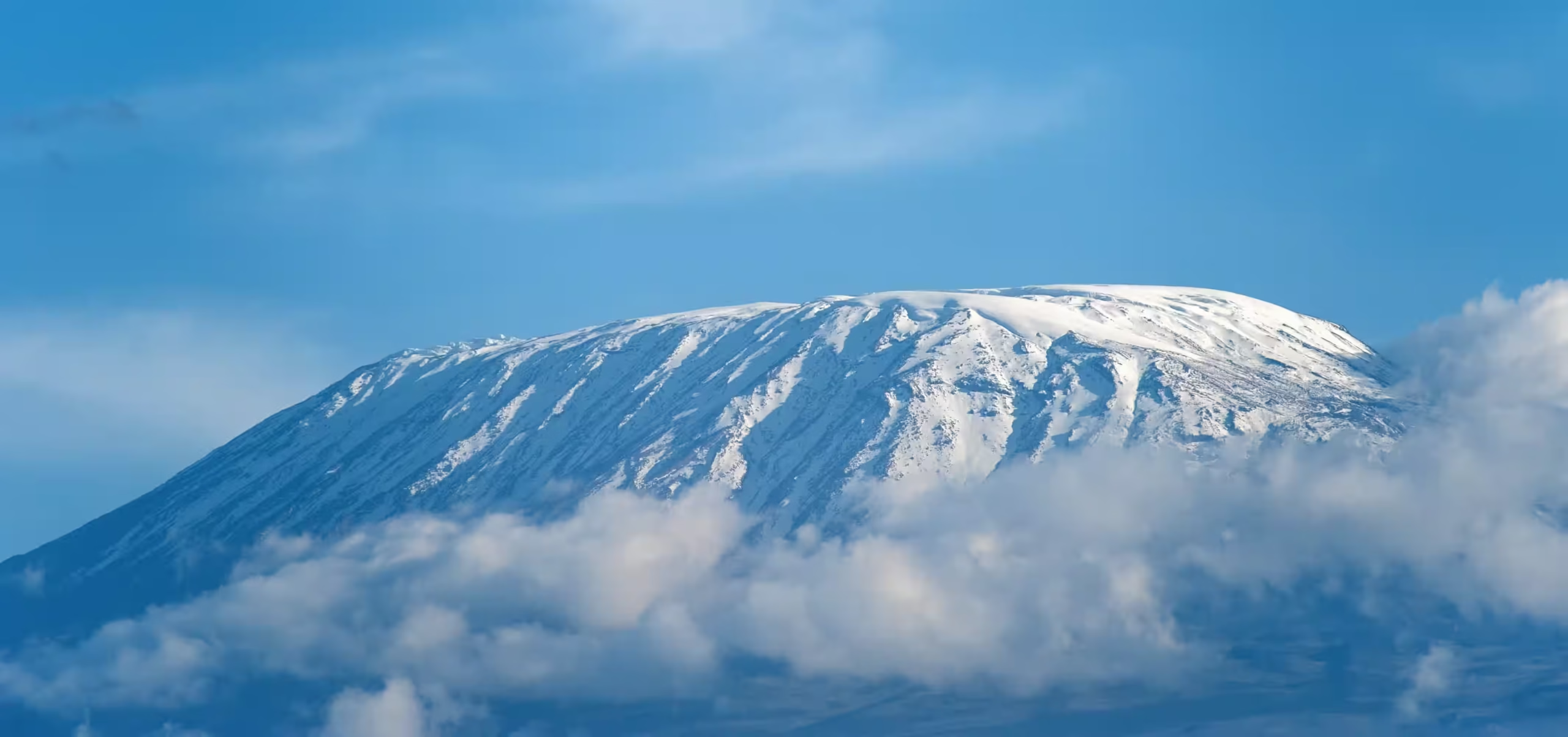
Mount Kilimanjaro summit with glaciers Tanzania
Kilimanjaro · 5,895m Uhuru Peak · Stella Point · 5,756m Africa's highest summit · Tanzania
Essential Information

Everything you need
to know.

What fitness level do I need?
Kilimanjaro requires good cardiovascular fitness — not elite athletic performance. The mountain is walked, not climbed technically. The challenge is altitude, not gradient. We recommend that clients can comfortably walk for six to eight hours per day at sea level before attempting the mountain. A training programme of four to six months — regular aerobic exercise, hiking with a loaded pack, some hill work — will prepare most people adequately. Altitude acclimatisation cannot be trained; only adequate time on the mountain addresses it.
What is altitude sickness and how do you prevent it?
Acute Mountain Sickness (AMS) occurs when the body does not have sufficient time to acclimatise to reduced oxygen at altitude. Symptoms include headache, nausea, fatigue, and loss of appetite. Severe AMS can progress to High Altitude Pulmonary Oedema (HAPE) or High Altitude Cerebral Oedema (HACE) — both medical emergencies. Prevention: adequate itinerary length (minimum seven days, eight recommended), the "climb high, sleep low" strategy built into acclimatisation days, hydration, and slow ascent pace. All Kisangara mountain guides carry pulse oximeters and are trained in altitude illness recognition and management. Diamox (acetazolamide) is available by prescription and can help with acclimatisation for susceptible climbers.
What is included in the Kisangara Kilimanjaro package?
All Kilimanjaro packages include: all park and conservation fees, certified lead guide and assistant guide, porter team (one porter per client minimum), all meals on the mountain, high-altitude camping equipment (tents, sleeping mats, dining tent, toilet tent), emergency oxygen, pulse oximeters, first aid kit, transfer from Arusha to the trailhead and back, accommodation in Arusha before and after the climb. Excluded: flights, travel insurance, personal climbing equipment, tips.
What is the best time of year to climb?
The two best climbing seasons are January–March (after the short rains, before the long rains) and June–October (dry season). July through September is the busiest period, with the most stable weather and the clearest summit views. The long rains (April–May) make the lower slopes extremely wet and slippery, and summit visibility is reduced; this period is not recommended. The short rains (November–December) are manageable and carry lower camp prices. January and February offer a combination of good weather, lower crowds, and the option to combine with a calving season wildlife safari.
Can I combine Kilimanjaro with a safari?
Yes — this is one of the most popular itineraries we arrange. The most common combination is a seven or eight-day Kilimanjaro climb followed by a five to seven-day safari in the Serengeti, Ngorongoro, or Tarangire. The logic is simple: after the mountain, the body craves warmth, rest, and good food, which a comfortable safari camp provides. The contrast between the summit environment at 5,895 metres and the hot plains of the Serengeti is one of the great experiential contrasts in travel. We can arrange the full combination from a single point of contact in Arusha.

"Summit at 06:12. The shadow of Kilimanjaro lay across Tanzania below us. Our guide — who has summited 340 times — said it still makes him cry. He was right. Nothing in fifteen years of travel has prepared me for this moment."

Michael T.Boston, USA · Lemosho 8-Day · July 2024

"I am 58 years old and had never done anything like this. Our guide adjusted the pace every hour. On summit night the cold was extraordinary — minus 15 at the crater rim. When the sun rose behind us I understood why people come back and do this again."

Patricia M.Toronto, Canada · Lemosho 8-Day · September 2024
Telephone & WhatsApp +255 755 002 886
Office Sokoine Road, Arusha, Tanzania
Hours Mon – Sat · 08:00–18:00 EAT

Based in Tanzania East Africa, we specialize in crafting unforgettable journeys that combine breathtaking landscapes, rich cultures, and authentic experiences. Whether you are seeking the thrill of a game drive across the Serengeti, climbing Mount Kilimanjaro, or the tranquility of Zanzibar’s beaches, we are dedicated to making every moment meaningful.

Visit our offices

23110 Olorien, Njiro Road, Arusha, Tanzania Parrot Hotel: Plot No. 48 Block No. 21, Kaloleni Area, Urban Arusha – Tanzania

Give us a call

Leave us an email

Loading itinerary…
Saved Trips