Kisangara Tours

Kisangara Tours — Header
CRATER
The World's Greatest Wildlife Arena

Ngorongoro Crater.

25,000 animals. Big Five guaranteed. The highest predator density on Earth.

Scroll
Destinations Serengeti National Park
Summit Mount Kilimanjaro 5,895m
Crater Ngorongoro · 25,000 Animals
Islands Zanzibar · Pemba · Mafia
Wildlife Great Wildebeest Migration
Western Gombe Chimpanzee Trekking
Southern Ruaha · Nyerere
Est. 2009 Kisangara Tours · Arusha
Destinations Serengeti National Park
Summit Mount Kilimanjaro 5,895m
Crater Ngorongoro · 25,000 Animals
Islands Zanzibar · Pemba · Mafia
Wildlife Great Wildebeest Migration
Western Gombe Chimpanzee Trekking
Southern Ruaha · Nyerere
Est. 2009 Kisangara Tours · Arusha
25,000Animals on the Crater Floor
610km²Caldera Size
30Black Rhinos
2.5MYears Old
260km²Crater floor
25,000Animals resident year-round
26Black rhino remaining
3M yrsOf human history at Olduvai
UNESCO World Heritage Site

A world within
a world.

The Ngorongoro Crater is the world's largest intact volcanic caldera — a collapsed volcano 600 metres deep and 260 square kilometres in area. Inside, a complete African ecosystem exists in miniature: savanna, forest, swamp, and a soda lake, populated by 25,000 animals who rarely leave. The crater is the most densely populated wildlife area in Africa.

The caldera formed approximately three million years ago when a massive volcano erupted and collapsed inward. The resulting basin slowly filled with sediment and vegetation, attracting wildlife that gradually became semi-resident. Today the crater walls form a natural enclosure for most species, creating concentrations of lion, elephant, buffalo, hyena, wildebeest, zebra, eland, and the critically endangered black rhinoceros that are impossible to replicate in open savanna conditions.

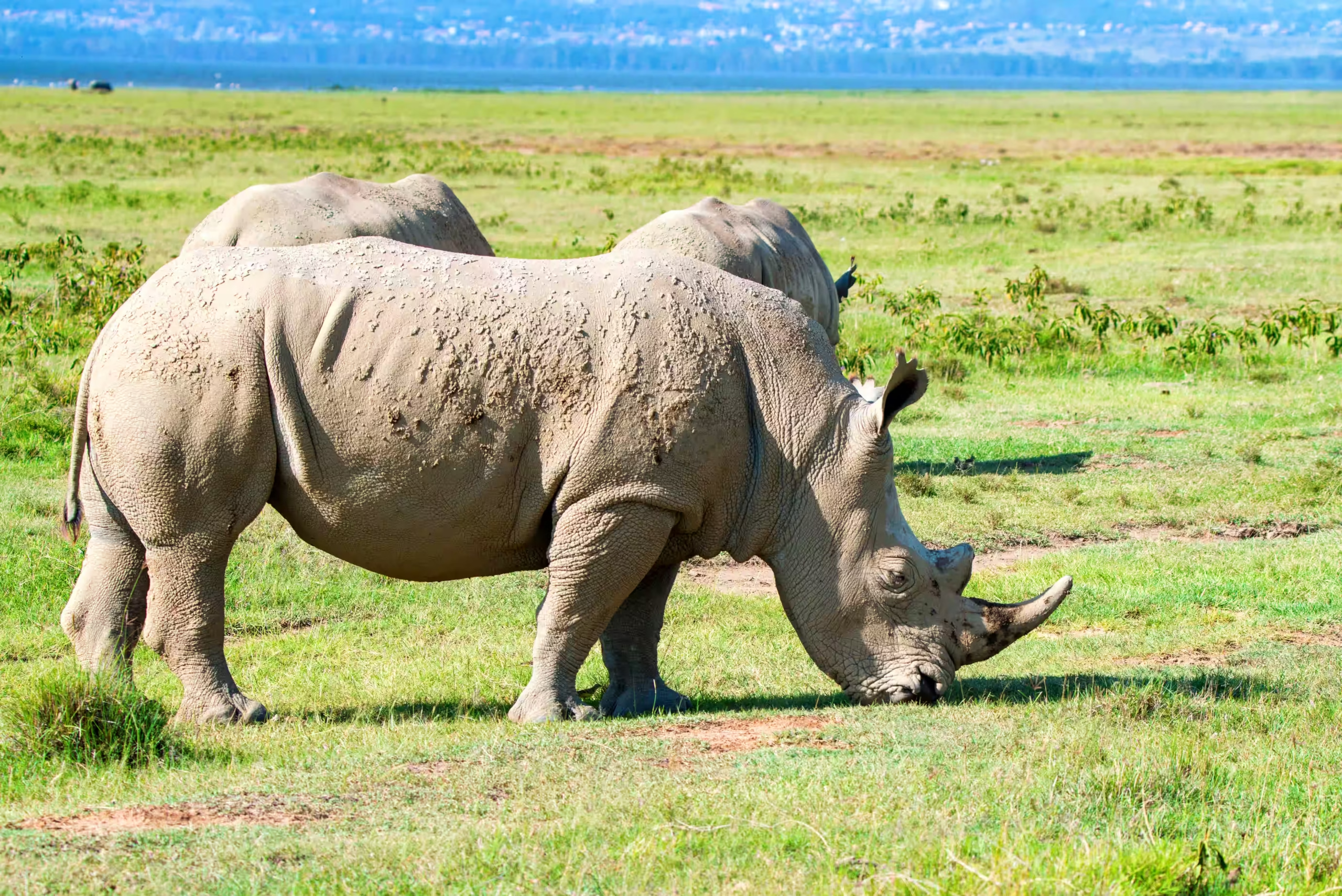
Twenty-six black rhinoceros live on the crater floor — one of the last viable wild populations in East Africa. The crater's enclosed habitat, permanent water sources, and intensive anti-poaching presence make this one of the safest rhino environments on the continent. Our guides know individual rhino by their ear-notch patterns and locate them reliably on a full crater day. An encounter with a wild black rhino at close range — an animal that has been poached to near-extinction across Africa — is one of the most significant wildlife experiences the continent offers.

The broader Ngorongoro Conservation Area contains one of the most important palaeontological sites on Earth: Olduvai Gorge, where Mary Leakey discovered Homo habilis remains dated to 1.8 million years ago in 1959. The gorge cuts through two million years of sedimentary strata in a single exposed cross-section. A visit to Ngorongoro that does not include Olduvai is, in our view, geologically and historically incomplete. We build Olduvai into all full-day crater programmes.

What the Crater Contains

The complete
resident roster.

Most Endangered

Black Rhinoceros

Twenty-six black rhino inhabit the crater floor — critically endangered, with a world population of approximately 6,000. The crater's enclosed nature and permanent anti-poaching presence make this one of the safest rhino habitats in Africa. Our guides locate them on approximately 70% of full crater days using individual identification by ear-notch pattern.

Highest Density

Lion — 60–70 Individuals

The Ngorongoro Crater has the highest density of lion in Africa — approximately 60–70 individuals in six to eight resident prides. The enclosed gene pool and moist crater conditions produce the distinctive black-maned males that characterise Ngorongoro lions. A full crater day produces a lion sighting on over 95% of visits.

Waterway

Hippo & Flamingo

Lake Magadi at the crater floor supports flamingo colonies that shift and reform as the birds feed. The Mandusi hippo pool holds a permanent pod that can be approached on foot with a ranger. The combination of hippo pool and flamingo lake at dawn — pink birds on black water, steam rising from the lake, the crater walls framing everything — is one of the great photographic moments in Africa.

Archaeological

Olduvai Gorge

Forty kilometres from the crater rim, Olduvai Gorge cuts through 1.8 million years of sedimentary deposits. Mary Leakey's 1959 discovery of Homo habilis remains here rewrote human evolutionary history. The gorge museum contains original fossils and explains the stratigraphy. A guided gorge walk is included in all full-day Ngorongoro programmes.

Doing Ngorongoro Properly

How to get the
most from the crater.

Most visitors spend four to six hours in the crater. We recommend eight. The difference is a rhino encounter, a lion hunt, and the golden hour light on the crater walls at ascent.

What time should I enter the crater?
As early as permitted — typically 07:00. The morning hunting window from 07:00 to 10:00 is the most productive period for predator activity. Early entry also means fewer vehicles on the floor. By 10:00, day-trip coaches from Arusha begin arriving. A 07:00 entry with a full day gives you three hours of quiet crater time before pressure builds.
Can I walk on the crater floor?
Walking is restricted to the Mandusi hippo pool area, which requires a ranger escort pre-arranged through Kisangara. The crater is otherwise vehicle-only. The hippo pool walk takes approximately 45 minutes and allows approach to within 20 metres of the hippo pod — a genuinely different experience from vehicle-based observation.
Is Ngorongoro worth visiting after the Serengeti?
Yes, unambiguously. The crater is a fundamentally different experience from the Serengeti. The black rhino, the distinctive black-maned lions, the flamingo lake, the enclosed caldera scale, and Olduvai Gorge are all experiences unavailable anywhere else. Guests who have visited the Serengeti multiple times consistently rate a full Ngorongoro day as among their best Africa wildlife experiences.
How does Ngorongoro fit in the Northern Circuit?
The standard Northern Circuit positions Ngorongoro as the midpoint between the southern parks and the Serengeti. One night on the rim plus one full crater day is the minimum; two nights with two crater descents allows different times of day and maximises rhino encounter probability. We recommend arriving at the rim the previous afternoon for sunset views into the caldera before the descent.
Ngorongoro Crater Tanzania wildlife
Ngorongoro · UNESCO World Heritage The crater floor at dawn 2,286m rim · 260km² caldera
Guest Voices

What the crater
does to people.

"The black rhino appeared from an acacia thicket twenty metres away. Our guide had tracked it for thirty minutes through the dung signs and footprints. It stood there for four minutes. I did not take a single photograph. I just watched."

James T.New York · Full Crater Day · 2024

"We arrived at the flamingo lake as morning light hit the water. Pink birds as far as we could see, framed by the crater walls. Our guide said nothing for fifteen minutes. He knew we needed silence to absorb it."

Hana K.Tokyo · Crater Dawn · 2024

"The crater is not a zoo. It is a functioning ecosystem with walls. The lion pride we spent two hours with had cubs born three weeks earlier. Real cubs, real behaviour, real Africa. This is what I had read about and never quite believed existed."

Sarah M.London · Full Day · January 2024
Telephone & WhatsApp +255 755 002 886
Office Sokoine Road, Arusha, Tanzania
Hours Mon – Sat · 08:00–18:00 EAT

Based in Tanzania East Africa, we specialize in crafting unforgettable journeys that combine breathtaking landscapes, rich cultures, and authentic experiences. Whether you are seeking the thrill of a game drive across the Serengeti, climbing Mount Kilimanjaro, or the tranquility of Zanzibar’s beaches, we are dedicated to making every moment meaningful.

Visit our offices

23110 Olorien, Njiro Road, Arusha, Tanzania Parrot Hotel: Plot No. 48 Block No. 21, Kaloleni Area, Urban Arusha – Tanzania

Give us a call

Leave us an email

Loading itinerary…
Saved Trips